
Connecting the Dots
Episode 142 - The Fed Liquidity Inflection Point

Welcome to the new subscribers that have joined us in the last week. The aim of this newsletter is to help you navigate the world of crypto. There’s an incredible amount of information out there so we try to distil it into the things you MUST know each week, covering both macro and crypto.
For snippets and analysis on institutional crypto trading, give our X account a follow HERE.
Onto the newsletter. Here’s what you’re getting this week:
Macro Update: Our latest view on the macro and its impact on crypto markets.
Crypto Native News: OKX partnership with Standard Chartered widens to the EEA, Kraken acquires Small Exchange, Uniswap now supports Solana.
Institutional Corner: Japan’s big 3 banks to launch a stablecoin, Japan’s FSA to potentially allow banks to invest in cryptocurrencies.
Charts of the Week: Perps volume on Solana hits a new record, highest DEX volume ever this week, combined ETH holdings of treasury firms and ETFs hits 10.3%.
Top Jobs in Crypto: Featuring Binance, Kraken, Fireblocks, VolpeX, Selini Capital, JP Morgan and BCB Group.
Macro Update
This is where we connect the dots between macro and crypto.
The Fed Liquidity Inflection Point
Another challenging week for crypto as we continue to digest the huge liquidation event which will take some time to settle down and stabilise. Such a large vol shock necessarily dictates that risk positions are reduced and patience will be required to allow the deleveraging to clear and fresh capital to be put back to work.
Trade war fears also continue to linger, despite a somewhat more conciliatory tone from the Trump administration. Trump saying on Friday that his proposed 100% tariff on Chinese imports was “not sustainable” and that he plans to meet Chinese President Xi Jinping in two weeks in South Korea to discuss trade tensions, adding to our conviction this is all just the “art of the deal” and the “TACO trade” remains alive and well.
Consequently, US equities managed a positive week, recovering a decent chunk of the tariff inspired sell off. Dovish comments from Fed officials also helped provide some calm, reinforcing market expectations for rate cuts, with JPow himself echoing previous comments that the “downside risks to employment” have shifted the balance of risks to the economy.
The Fed’s Beige book noting activity little changed since the previous report, but that consumer spending “inched down” whilst prices rose further and employers reported lowering headcount - all very much in keeping with our Goldilocks view of a slowing, not collapsing economy with sticky, not accelerating inflation, providing the space for the Fed to continue to ease rates ✅
The most important comments from JPow however came in relation to Quantitative Tightening (QT) as he suggested the Fed is nearing the end of its QT programme, noting the central bank’s balance sheet is approaching the level of reserves it considers to be “ample.” However, citing the tightening of liquidity indicators such as firmer repo rates and localized funding pressures, suggests bank reserves are nearing the lower end of “ample” levels of reserves and the Fed is growing wary. (“Ample reserves” ensure banks have sufficient cash to perform daily operations, without small changes in reserves putting undue pressure on rates which the Fed can’t easily control.)
Indeed, on Wednesday, usage of the Fed’s Standing Repo Facility (SRF) reached its highest levels since the Covid pandemic, excluding end-of-quarter spikes, with US banks borrowing $6.5bn of cash overnight. This borrowing came as repo rates peaked at 4.36% on Wednesday, eventually settling at 4.12%.
What does this mean and why is this important?...
Increased usage of the SRF is a sign of tightening liquidity in the banking system.
We’ve written a lot about the Fed’s Reverse Repo Facility (RRP) which allows banks and money market funds to park excess cash reserves overnight with the Fed. We’ve documented how the run down of the RRP, which stood above $2.3trn in April 2023 (due to the excess cash from QE sloshing around in the system) was a major liquidity injection which has powered the bull market in stocks and crypto.
What was “teasing” this money out of the RRP, was the move from Treasury Sec Yellen, and continued now by Treasury Sec Bessent, to reweight the huge US debt issuance to shorter date T-bills. Cash left the RRP in search for higher yielding T-bills and this acted as a huge injection of cash liquidity into markets.
The RRP is now almost fully tapped out (at just $4bn). However, excess bank reserves on the surface appeared large enough to fill the liquidity vacuum that the RRP was filling which is why we haven’t been too concerned…until now 👀
The technical bit…
The RRP along with Interest on Bank Reserves (IOBR) is used by the Fed to keep a floor on rates, to maintain Fed Funds at the set target rate (if the system is flooded with cash, putting downward pressure on rates, RRP and IOBR paying a higher rate will alleviate pressure on the market floor). Attempting to maintain a cap on rates is the Fed Standing Repo Facility (SRF). When repo rates start to rise due to a lack of available cash/lending, eligible financial institutions can access the SRF which helps alleviate funding stress in the broader market ✍️
There are however limits both in terms of who is eligible to tap this facility and caps on borrowing etc. It’s also more expensive to borrow from, so typically those using the SRF are deemed to be struggling to find liquidity elsewhere.
Given this, it’s notable that we have seen the highest level of usage of the SRF outside of Covid. JPow explicitly alluding to signs of tightening liquidity was perhaps a “canary in the coalmine” of underlying stresses in the system.
Perhaps Bitcoin’s recent under performance, as the ultimate barometer of liquidity, has been flashing some warning signs of that liquidity tightening 🤔
Adding to the sense of unease, regional banks in the US came under heavy pressure this week after two banks, Zions Bancorp and Western Alliance Bancorp, disclosed issues with borrowers, stoking nerves about the credit market. Zions announced it would take a $50mio loss in Q3 over a bad loan, whilst Western Alliance announced it was suing a borrower over allegations of fraud.
Whilst these two issues appear more linked to fraudulent behaviour, its timing was bad given the underlying whispers of some funding and credit market stress 😬
Cautious optimism…
Bringing this all together, whilst we maintain a constructive view for the underlying macro dynamics for a continued bull market in both equities and crypto, we think the underlying flickers of bank funding stress auger for caution ⚠️ Markets ultimately are a function of rates and liquidity and whilst “liquidity” on an aggregate scale remains high and rising, if the flow of banking “system liquidity” starts to dry up, then this will have a detrimental impact on both equities, Bitcoin and the wider crypto space.
Bitcoin we feel after last week has had its “deleveraging” moment, but equities perhaps have more room to correct. Whilst Bitcoin can outperform, broad risk under pressure will still weigh on the wider crypto complex.
Now to be clear, we’re not saying we’re at this inflection point just yet, but there are a few signs of liquidity problems bubbling underneath the surface. Much will depend on how proactive the Fed is in responding to these underlying signs of stress.
Ultimately, with the RRP depleted and with an ever growing fiscal deficit to fund, the Fed will not only have to end QT, but also restart monetary operations to supply liquidity to repo and money markets. Whilst this will be different to QE in operation, practically it will be the same in terms of liquidity impact.
When that intervention from the Fed comes, that’s when Bitcoin will really take off in a parabolic move akin to what we’re witnessing currently in gold. Of that inevitable outcome, we have no doubt. The only question is whether the path to that outcome involves a deeper market and risk correction, which will depend on the Fed’s proactiveness to tightening system liquidity.
Caution is therefore warranted short term as these dynamics play out, but this is setting up ultimately for the parabolic leg higher in 2026 🚀
Native News
Key news from the crypto native space this week.
OKX announced this week that it was expanding its partnership with Standard Chartered into the European Economic Area (EEA). Earlier in the year OKX first partnered with Standard Chartered in the UAE to launch a collateral mirroring programme a service that allows institutional clients to keep their assets securely with a Global Systemically Important Bank (G-SIB) while mirroring those balances into OKX for trading. OKX are extending these services to all if their customers across the EEA. Read the full release from OKX HERE.
Kraken announced it has acquired Small Exchange, a CFTC-licensed Designated Contract Market (DCM), from IG Group., for $100 million. The press release says “This move lays the foundation for Kraken to launch a fully U.S.-native derivatives product suite, creating a deep, sophisticated onshore venue in the world’s largest capital market.” A DCM authorises Kraken, under the oversight of the Commodity Futures Trading Commission (CFTC), to design and create markets for exchange-listed derivatives in the U.S. Arjun Sethi, co-CEO of Kraken said “Kraken’s acquisition of a CFTC regulated Designated Contract Market creates the foundation for a new generation of United States derivatives markets. It is designed for scale, transparency, and efficiency. “This step connects spot, futures, and margin products inside a single regulated liquidity system, reducing fragmentation, lowering funding latency, and bringing onshore the kind of access and performance that has mostly existed offshore. Under CFTC oversight, Kraken can now integrate clearing, risk, and matching into one environment that meets the same standards as the largest exchanges in the world.
Uniswap Labs, the largest DEX on EVM networks, announced that Solana is now supported on Uniswap Web App. This marks the first time Uniswap has enabled trading for tokens on a non-EVM network. the press release says that this change has been one of “the most requested features from our community.” Until now, Uniswap Web App users had to leave the app to trade on Solana. With support built in, they can now access tokens across Ethereum, Solana, Unichain, Base, and more – all from the Uniswap Web App. Next, Uniswap say they are exploring bridging, cross-chain swaps, and full Uniswap Wallet support, making it easier to move across chains without leaving Uniswap apps.
Institutional Corner
Top stories from the big institutions
Japan’s three major banks, MUFG, Sumitomo Mitsui, and Mizuho, are collaborating to launch a stablecoin pegged to the Japanese yen and US dollar. This initiative aims to facilitate seamless cross-border settlements, with Mitsubishi Corporation serving as the first application scenario. The three banks collectively have over 300,000 major business partners.
Japan’s Financial Services Agency (FSA) is considering revising regulations to allow banks to hold cryptocurrencies such as Bitcoin for investment purposes. The move aims to align with the growing trend of crypto trading, enabling banks to trade digital assets like stocks and government bonds. In addition, regulators plan to let banking groups register as crypto exchange operators to enhance market trust and make it easier for individual investors to participate.
Charts of the Week
Because charts are just as important as macro.
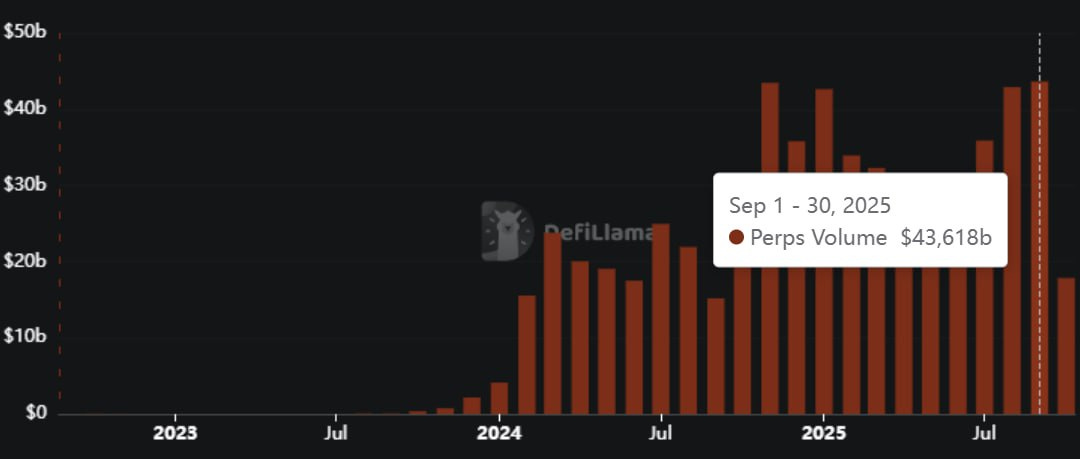
Perps volume on Solana hit a new record of $43.61 billion in September.
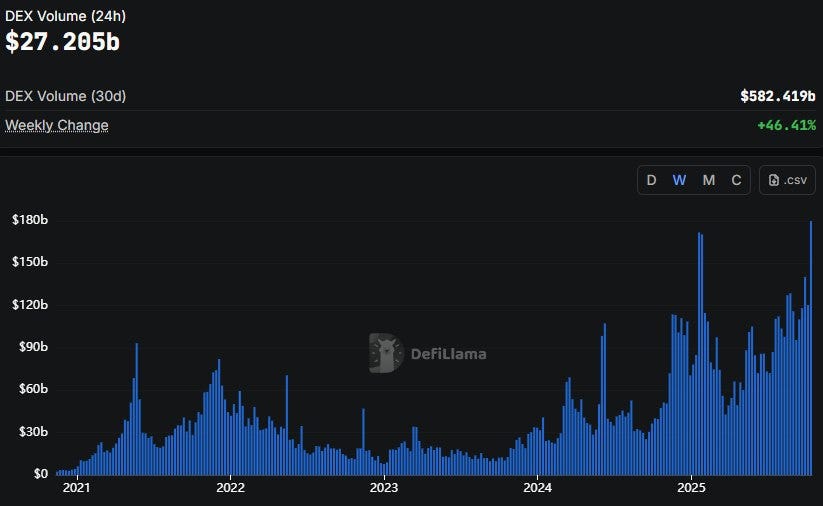
This week has had the highest DEX volume ever. Surpassing even the week of the Trump memecoin launch.
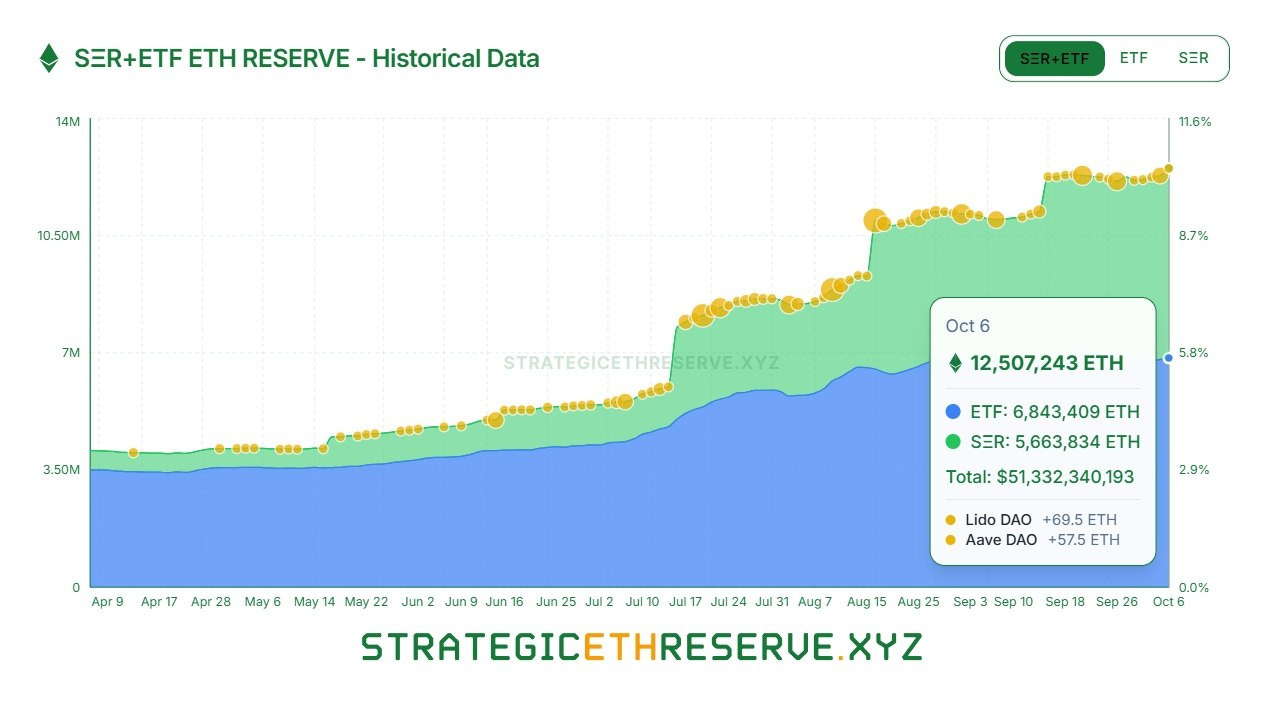
The combined ETH holdings of treasury firms and ETFs have risen to 12.50 million ETH, representing 10.31% of Ethereum’s supply.
Top Jobs in Crypto
Well, we all want to work in Crypto don’t we. Here’s a bit of help on your job search!
Senior OTC Sales Trader at Binance
Senior Product Manager Earn Core at Kraken
Sales Director, Payments at Fireblocks
Business Development Manager at VolpeX
Options Trader at Selini Capital
Kinexys Digital Assets - Commercial Product Director – Executive Director at JP Morgan
Senior Product Marketing Manager at BCB Group
DISCLAIMER: The content in this newsletter is not financial advice. This newsletter is strictly educational and is not investment advice or a recommendation to buy or sell any assets or to make any financial decisions. Crypto markets are volatile, please be careful and do your own research.
as always - great one. Especially, on the macro side today!